MDM Reference • Wave forms in models
Wave Forms in Signal Models
A wave form is a quantity that varies with a running variable, usually time, and that repeats or nearly repeats in a recognisable way. Treated as a mathematical object, it may be summarised by a few numbers or studied in full as a curve.
The elementary wave
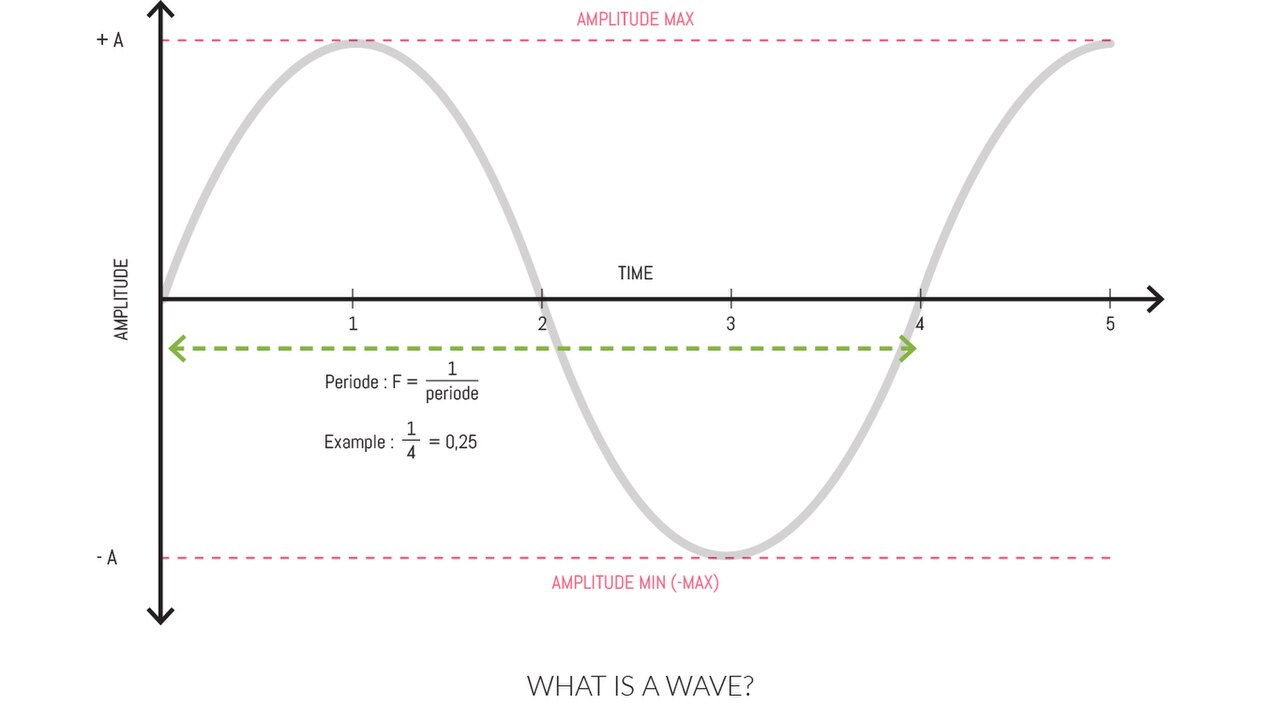
The simplest wave form is the sinusoid, fixed by three numbers: an amplitude that sets its height, a frequency that sets its rate of repetition, and a phase that sets where it begins. Written as the sine of a linear function of time, it is the building block from which every more involved form is assembled. Its period is the reciprocal of its frequency, and its mean over a whole period is zero.
Superposition
When two waves occupy the same channel they add, and the sum may be a new shape entirely. Equal rates with opposed phases cancel; equal rates with matched phases double; unequal rates produce a slow beating. Superposition is a property of the addition, and it is the reason a complicated wave may be read as a collection of simple ones rather than as an irreducible whole.
The wave as a stochastic realisation
In many studies the wave is not a fixed pattern but one instance of an irregular process. The readings at successive instants are then random variables, and the whole wave is one realised path of a stochastic process. Once the wave is seen in this light, the statistical vocabulary holds: it has a mean level, a dispersion about that level, and joint behaviour between readings separated by a stated interval.
Amplitude and phase as a pair
A single sinusoid is often written as a pair, an amplitude and a phase, or equivalently as two quadrature components. The pair is convenient because the operations of shifting and scaling act on the two parts separately. For an irregular wave the pair is defined only over a short window, since the amplitude and phase may drift from one instant to the next.
Sampling the wave
When a wave is read at equally spaced instants, the readings form a series. The spacing must be fine enough to capture the fastest variation present, or the reading will misrepresent it. The misrepresentation of a rate too fast for the spacing is a distinct phenomenon with its own name, and the reader is warned that it is not repaired by any later step.
Uses and cautions
Wave models serve in acoustics, in the study of mechanical vibration, in the account of electrical quantities, and in the modelling of periodic natural records. In each setting the caution is the same: a fitted wave describes the record only within the conditions under which it was taken, and extrapolation beyond those conditions is a fresh claim requiring fresh evidence.
A caution on fitting
A wave fitted to a record describes that record under the conditions in which it was taken, and no others. A record of steady repetition may be described by a few rates, but the same account used outside that record is a fresh claim. The reader is urged to keep the conditions of the record beside the wave that describes it.